June
Newsletter
Mary Atwater's Recipe Book CD
Click to
download newsletter PDF file
Click for Purchase
Information and CD Helps
June Guild
Meeting
What:
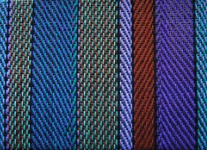
Tartan Weaving and a Waulking, by Anne
Carroll Gilmore
When:
Saturday,
June 6, 10:00 to 1:00, with potluck lunch
Where:
Pioneer Craft House, 3271 S 500 E · Salt
Lake City
Anne's presentation on Tartan weaving
will last from 10:00 until 11:30. We will have a
potluck lunch from 11:30 to 12:30, and then the
waulking will be held at 12:30. Please plan to bring
a potluck dish to share.
At our June Guild meeting, Anne will be giving a
complete overview and demonstration of Tartan
weaving techniques and methods. She will cover
Tartan history and myths, adjusting thread counts
for yarn size and project/Tartan type, tips for
rhythmic and consistent/even beat, and many other
useful weaving tidbits—such as several types of weft
color changes and which ones are most effective to
the project. Special twill selvage threading will be
discussed, along with color theory as it applies to
plaids.
We will briefly discuss the making of kilts and some
attention will be given to women’s wear in the
highlands which will include the design, folding,
and wearing of the woman’s arisaid. This discussion
will be accompanied by many handouts, so even if you
are a seasoned weaver who knows 2/2 twill inside and
out, Tartan weaving can be a great color educator
as well as the perfect vehicle for honing your basic
weaving skills. We'll cap this with a traditional
highland style "waulking," so come prepared to get
damp and fuzzy!
Anne Carroll has been fascinated with interlacements
of color and texture all her life. She was brought
up in Colonial Williamsburg, a living history
community in Virginia. She was introduced to
traditional methods of fiber processing and fabric
construction at an early age by renowned Scottish
Master Weaver Norman Kennedy who was an interpreter
there. She also began knitting and designing around
the age of 8, and early intensive training in
Scottish Tartan Weaving
served to hone her basic skills and helped to
develop her noted eye for proportion and color
harmony. She has been fortunate to study under some
of the best teachers and mentors in textiles: Sharon
Alderman, Kaffe Fassett, Randall Darwall and of
course Norman Kennedy. She has worked in fiber full
time for the past 18 years, and from her studio in
the beautiful and inspiring mountains of Park City,
Utah, for the past 13 years.
Basket for IWC
We will be collecting fiber-related items at the
June Guild meeting for our Guild's IWC basket. At
each conference, baskets are raffled off to
raise money. Our Guild's basket will have the theme "A Tribute to Mary
Atwater." We will have several items related to Mary
Atwater, but
the basket will mostly be made up of yarn, fiber, or
small pieces of fiber equipment. Would you please
look through your stash and see if
you have anything you could donate. If we have more
than will fit in one basket, we will donate the
items for the IWC board to use in other
baskets.
Silent Auction
A longtime member of our Guild, Roz McGee, has
donated many of her books, yarns, and pieces of
weaving equipment to the Guild in order
to benefit the Guild and its members. We are deeply grateful to her for
doing this. At our June meeting, we are going to
have a silent auction
for the items she has donated. The auction will
begin at 10:00 and be completed at the end of the
lunch time. If anyone can come only to the
potluck lunch, they will still have a chance to bid
on the items. There is a Gilmore wooden swift,
bobbin winder, many copies of Handwoven
magazine, weaving books, etc. It will be worth
coming to bid! The proceeds of the auction will go
to the Guild.
~~~~~~~~~~~~~~~~~~~~~~~~~~~~~~~~~~~~~~~~~~~~~~~~~~~~~~~~~~~~~
President’s Message
In
case you haven't noticed, I really like the Guild!
The members of this Guild have meant so much to me
in so many different ways. Recently I received yet
another benefit from some Guild members. I enjoy
doing small stitchery projects, and I recently
decided to make a set up embroidered pillowcases
because I got spoiled using the ones made by my
greatgrandmothers (I wore out all the ones they had
made).
I began with a set of beautiful pillow cases cut
from lengths of pillow tubing, made decades ago out
of beautiful cotton. Charlene Lind had given me
these lengths, which had belonged to her mother.
(That's the first Guild member helping me.) Then I
found a book on embroidery that I had checked out of
the Guild library (that's #2), and I found a picture
of some stylized embroidered flowers that I wanted
to put on my pillowcases. I called ReNee Page
because I knew she owned the book. She and I each
looked at our own copies of the book, and ReNee told
me the name of each stitch that had been used to
create the flowers (#3).
I showed the design to Jane Ann Peters and told her
what I planned to do with it, and she proposed a
much better way of adapting it to the pillowcases
(#4). Then I got an e-mail from ReNee, who had
recently purchased an embroidery book and had found
an unusual and very practical way of transferring an
image to cloth (#5). The method is so simple and
useful that I want to share it with you so that I
can be one of the reasons you have learned something
from a Guild member today!
Tulle transfer method: Place a piece of non-waxed
kitchen paper (lunch wrap) or tissue paper over your
design sheet. Next, place a piece of fine bridal
tulle or netting over the tissue. Use a permanent
black fine-tipped laundry marking pen to trace over
the design elements, thereby transferring the
desired pattern to the tulle. Allow the pen marks to
dry for several minutes. Remove the pins and discard
the paper (which was only there to protect the
original pattern sheet). Set the original pattern
sheet aside.
Pin the tulle securely to your embroidery fabric,
and use a water erasable fabric marking pen to trace
over the lines made by laundry marker. The fine
holes in the tulle allow the tip of the marking pen
to penetrate and thus mark the design elements onto
your embroidery fabric.
The piece of tulle is now permanently marked with
this design, so you will be able to use it again or
perhaps use portions of the design on another
project. You can also reverse the design by turning
the tulle over. Clever, huh!
Thanks to all of you for the many ways you have
enriched my life. I have loved serving as the Guild
president over the past two years and look forward
to many more years of associating with all of you.
Much love, Susan
Susan Hainsworth
~~~~~~~~~~~~~~~~~~~~~~~~~~~~~~~~~~~~~~~~~~~~~~~~~~~~~~~~~~~~
~~~~~~~~~~~~~~~~~~~~~~~~~~~~~~~~~~~~~~~~~~~~~
Napkin Exchange Study Groups
See the Newsletter
~~~~~~~~~~~~~~~~~~~~~~~~~~~~~~~~~~~~~~~~~~~~~
|